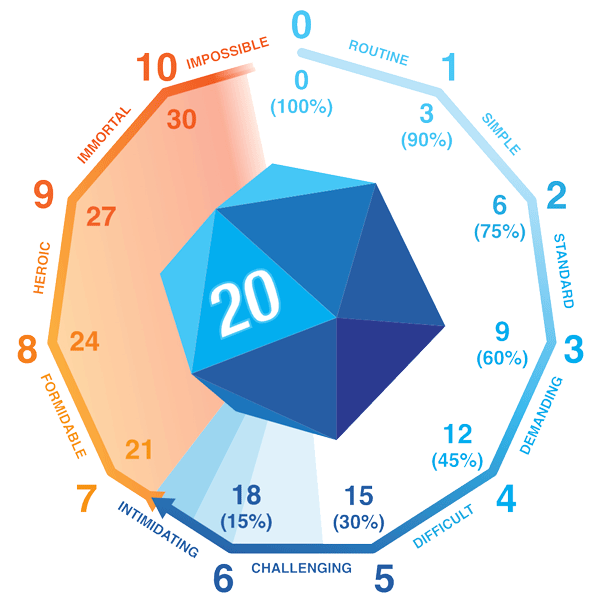
 1. As the player character (PC), you tell the game master (GM) what you want your character to do. This is called the task.
Cypher is a roleplaying game featuring a fun, fast-paced narrative experience, designed to allow you to play a game of dungeon fantasy, hard science fiction, swords & sorcery, space opera, postapocalypse, superheroes, and much more—really, any genre you can think of—without kludging together rules. The game master sets the scene, and you and the other players explain how your characters respond. The scenes play out in your joint imaginations—your character might start in a town suffering from a curse, travel across a stark wilderness, and eventually end up at the site of an ancient ruin—and before you know it, you've got a story as compelling as any you've read or watched.
The rules and the dice help the game run smoothly, but it's you, the other players, and the game master, not the rules or the dice, that direct the action and determine the story—and the fun. That's because Cypher has several key innovations that make the experience richer, smoother, more intuitive, and the reason Cypher might be the RPG you've been waiting for.
This is how you play Cypher:
1. As the player character (PC), you tell the game master (GM) what you want your character to do. This is called the task.
2. The GM rates how easy or hard that task might be on a scale of 1 to 10—this is called setting the difficulty. A task rated 1 is so simple that anyone can accomplish it nearly every time, while a difficulty 10 task is effectively impossible for normal humans.
3. You and the GM determine if anything about your PC can reduce the difficulty, making it more likely that you succeed. This is called easing the difficulty, and it might be a combination of your character's skill, equipment, and/or putting extra effort into the task.
A task's difficulty is reduced by 1 for each step that you ease it. For example, if your character has to succeed at a difficulty 4 persuasion task, and you're trained in persuasion, the difficulty is reduced to 3. But if an ally also helps you persuade, the difficulty is eased by another step, becoming a difficulty 2 persuasion task.
4. The GM uses the task difficulty to determine your target number—the number you must roll on the d20 to succeed at the task. The target number is always three times the task's difficulty, so a difficulty 2 task has a target number of 6, while a difficulty 5 task has a target number of 15.
To succeed at the task, you must roll the target number or higher on a d20. The GM doesn't have to tell you what the difficulty or target number is, but they might give a hint, especially if your PC would reasonably know if the action was easy, average, difficult, or impossible.
5. You roll a d20. If the roll is equal to or higher than the target number, you succeed. If not, you probably fail. Either way, the task attempt is considered youraction.
That's it. That's how to do anything, whether it's identifying a strange device, calming a raging bull, jumping from a burning vehicle, swinging a battleaxe at a mutant beast, swimming across a turbulent river, using an ability to control a foe's mind, dodging a laser blast, or parleying with an ambassador from an alternate dimension. Even if you ignored all the other rules, you could still play Cypher with just his information.
The key features here are choosing a task and determining how much that task is eased or hindered before rolling. (The GM rates the task's difficulty, which sets the target number.) When you're ready to delve deeper into the rules, refer toRules of the Game for a comprehensive presentation.
Cypher's dozens of character types put you immediately in the action as a starship pilot, a druid, a swashbuckler, or nearly anything you want to play. At the same time, because of how character building works in Cypher, you have powerful customization options that allow you to play exactly the character you want.
That's because there's more to your character than just your type—you also add a descriptor and focus of your choice. It's as simple as building a character sentence.
To create your character, you build a simple statement describing them: “I am a [fill in an adjective here] [fill in a noun here] who [fill in a verb here].”
Thus: “I am an adjective noun who verbs.” For example, you might say, “I am an Honorable Mage who Quells Evil” or “I am an Inquisitive Powerstar who Grows to Towering Heights.”
In this sentence, the adjective is called your descriptor.
The noun is your character type.
The verb is called your focus.
In some games, you might also have a species, which becomes another part of your character sentence. For instance, you might be an Honorable Elf Mage who Quells Evil. When a species name in this book is capitalized (i.e. Human), it refers specifically to the game term and may involve game rules or effects. When a species name is lowercase (i.e. human), it's a general descriptive term.
For instance, you're not just a starship pilot, but maybe one who is always coming up with cunning schemes and secretly has psionic abilities: a Clever Starpilot who Commands Mental Powers. You're not just a druid, but perhaps one who excels at getting what you want and can call upon the powers of the earth to give you tough, rocky flesh: a Charming Druid who Abides in Stone. And you're not just a swashbuckler, but possibly a surprisingly brainy individual who learned to master a demon's fleshwarping curse: an Intelligent Swashbuckler who Changes Shape.
Beneath your character sentence—your descriptor, type, and focus—you begin with the core of a character. This core character gives you base stats, training in a couple of skills appropriate to your genre, and a few other important foundational elements, including how much baseline punishment you can take.
Your core character is an entirely playable (if slightly uninteresting) character. It's the foundation onto which you layer the words in your character sentence—words like “Intelligent,” “Chaotic,” “Barbarian,” “Android,” “Employs Magnetism,” or “Crafts Illusions”
Each part of the sentence adds new capabilities and abilities, making your character more capable, dynamic, and extraordinary.
When you're ready to begin creating your character, refer to The Core Character to get going.
You've got the basics, you know how to resolve an action, and you have an idea of how a character is created. But you've still got questions. You could read the whole book to get your answers, or you could just look at the sections mentioned here.
Read here to learn about the game's three stats that measure aspects of your character—Might, Speed, and Intellect. Each of these offers a pool of points that you can use to accomplish things. Your character will always have a skill or two to reflect what they're really good at.
First of all, start with a core character and then add the parts of the sentence: an adjective (a descriptor), a noun (a type) and a verb (a focus). The type and the focus are based on the genre or subgenre you're playing in, so find out from the GM or the other players what hat will be and it will narrow your choices a bit:
You might also need to reference Horror or “…and There's Magic”, but they're different, so ask your GM.
If it's appropriate for your setting, take a look at the races offered by your genre.
Distances in Cypher are abstracted to immediate, short, long, and very long. Find out how far you can move and more. You might want to also reference athletics and acrobatics. And of course, there are always vehicles.
If you're attacked, you most likely want to either dodge that attack or block it. Be wary, though, as there's also poison, disease, and even mental attacks..
When you get hurt, you suffer a minor, a moderate, or a major wound. Some wounds might hinder you. There are various ways you can heal or recover from such injuries.
Look to equipment section, and note that it's organized by genre. Each type also provides a handy list of starting equipment for your character if you choose that route.
You gain XP (experience points). You will also gain resource points for things you want to accomplish “off stage,” so to speak, like building a house, sharpening your sword, brewing a potion, or fixing the hyperdrive on your spaceship.
Every character has skills and abilities that they choose and can rely on. But characters in great stories also seize the moment when they need to and embrace a sudden bit of inspiration, show clever ingenuity, or react to an unexpected opening or opportunity in the middle of the action. These abilities are cyphers, and they are ephemeral, used once and soon replaced by another, granting a new opportunity. Since they ride upon the winds of fate, they are given by the GM (often determined randomly).