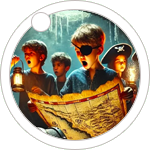
 Childhood Adventure
[Genres]
Childhood AdventureChildhood adventure books, television shows, and movies are a genre that often mix elements of horror or science fiction. But the focus of the genre is on the kids, usually in the range of eleven to seventeen years of age, who encounter strange and unexplained happenings, who must then do something about it. Childhood adventure distinguishes its young characters as active heroes, not victims. Normally, protecting children is a common motivating influence for adult characters in all kinds of stories and games. By focusing on the child as the protagonist instead, a reader, viewer, or an RPG game player gains a real sense that the stakes are somehow higher.
Popular childhood adventure scenarios include children finding and aiding a misunderstood alien, children dealing with the aftermath of a disaster in the absence of all the adults who are dead or missing, or children fending off the attacks of some kind of horrific monster that adults believe to be imaginary. Many other childhood adventures are possible, and fiction is littered with them. One of the most popular follows the exploits of Harry Potter and his friends as he learns of his wizarding background and begins instruction in the magical arts, .
In fact, childhood adventure stories are so popular that literature has its term for the genre: Young Adult fiction (usually abbreviated to YA fiction).
In many cases, childhood adventures in RPGs don't make long-term campaigns, but instead serve as short-term experiences where players try something new, or at least something they don't normally do: play as a teenage (or pre-teen) character.
Childhood adventures have their biggest impact on players if the setting is somewhat familiar. Which means that a blend of modern with some science fiction, fantasy, or horror is the most popular. By using the modern world as the basis for a childhood adventure, the GM doesn't need to spend too much time doing basic worldbuilding.
The task before the GM is instead that of devising an overarching plot that'll challenge players. But as mentioned, the novelty of playing as children, all by itself, can go a long way, all on its own. When you're a kid, the importance of schoolwork, being home before dark, and watching after a younger sibling takes on additional import. When the GM throws in a monster in the basement, a face in the window, or a dream that everyone shares, seeing the threat through a child's eyes is part of the charm.
One way to create a childhood adventure is to make sure you're aware of all the previous art to draw inspiration and a sense of priorities and mood from. For starters, watch the eight episode miniseries Stranger Things by the Duffer Brothers, the movies Super 8 by J. J. Abrams, E.T. by Melissa Mathison (screenplay) and Steven Spielberg (director), and The Goonies by Chris Columbus (screenplay), Steven Spielberg (story), and Richard Donner (director). Then read some childhood adventure fiction, this includes both the previously mentioned Harry Potter and the Sorcerer's Stone by J. K. Rowling and the classic To Kill A Mockingbird by Harper Lee. If you've got the time and the interest, continue with A Wrinkle In Time by Madeleine L'engle, The Lion, The Witch, and the Wardrobe by C. S. Lewis, The Golden Compass by Philip Pullman, and so many more.
A major theme of childhood adventure is simple: kids helping kids. Sure, kid PCs might also help their parents, their mentors, and so on. But helping your friend who's being haunted, who is lost, who is different, and who is missing is a great place to start.
Another theme is how kid PCs deal with the issues facing them either without the notice of the adult world or in the face of outright disbelief and claims of "imaginary friends" and similar from adults who kids finally relate their problems to. Some parents simply don't have time to listen to their child describe what is immediately assumed to be just a story. Others will listen and pretend to go along with a tall tale of monsters in the garden shed, but they don't actually believe it. Pretty soon, kid PCs must realize they've got to take care of the problem on their own.
That said, kid protagonists might require a patron or mentor to help them accomplish goals that can only be accomplished in the adult realm. For instance, in the Danny Dunn series, the protagonists rely to a greater or lesser extent on Professor Euclid Bullfinch as their patron. A professor makes a great patron, but other NPCs could accomplish similar tasks. An uncle who's a soldier. An older sibling who's a priest. Maybe even an aunt who's secretly a witch.
Kids also need a "safe" place to plan their adventures. This could be as simple as a friend's mom's basement, with a handy supply of pizza wheels, potato chips, and soda laid in by that friend's mother. A treehouse, a room at school set aside for the debate team, a shed that a friend's dad said the kids could use, or even a secret meeting place in an abandoned opera house at the center of town could also serve. What's important is that kids should feel somewhat safe in their secret base, at least most of the time. You might include one scenario where the base is under attack, but that should be the exception. Kids need a fallback or the childhood adventure you're running risks turning into something much more harrowing and bleak. This might be just fine, if it suits your tastes. After all, the movie Pan's Labyrinth by Guillermo del Toro depicted a kind of childhood adventure, though your interpretation of what was going on can go one of two ways.
Finally, kids need some means of getting around. In many cases, bicycles are perfect. Not only because they allow the characters mobility, but because of what they represent: freedom. Bicycles don't require asking a parent or older sibling for a ride; they allow kid PCs to be autonomous, at least within a limited range. In a more urban environment, kids probably have subway passes, or in a setting that isn't a throwback to the 80s, maybe a ride-sharing app pre-installed on their smartphones by their parents.
The key to a great childhood adventure is to get the PCs invested in their characters. Roleplaying a youthful character might be a challenge to some, but it is well worth the extra work once everyone gets into the spirit
The Childhood Adventure Threats table provides more dangers to throw at your PCs playing as kids. These dangers can be incidental to the larger plot or help you generate a larger plot. They're not meant to be the major story arc, though you could probably spin some of them out to serve that purpose. Most of these threats should be presented as GM Intrusions. If you are rolling for results instead of choosing, ignore or change results that don't fit your game. For instance, if the PCs are dealing with a science fiction-inspired alien, ignore the results that suggest that ghosts or killer clowns come after the characters.
| 1 | Bullies in the alley: Three bullies ambush one or more of the PCs at an unexpected location or time. |
| 2 | Freak storm (level 1): Inflicts 1 point of ambient damage per minute each minute the character fails a difficulty 3 Might defense task; reduces vision and chills characters, threatening worse with prolonged exposure. |
| 3 | Rotten board (level 3): While exploring the haunted house, old farm, or similar structure, a rotten board plunges PC into basement inflicting 3 points of damage on a failed difficulty 4 Speed defense roll. |
| 4 | Bicycle breakdown: One of the characters' bikes throws a chain, requiring a difficulty 3 Intellect task to repair it. |
| 5 | Detention: A character is set up by an NPC child, who threatens to embroil the character in an altercation where a teacher or other authority figure will be forced to step in and punish the offenders with detention, a truancy violation, or an unexpected trip home. |
| 6 | Sinister authority figure: A principle, a police officer, a mysterious man in a suit with a government badge, or some other authority figure takes an interest in the character(s) and begins to work against them. |
| 7 | Bad dreams: One PC suffers from a series of debilitating nightmares, and must succeed on a difficulty 3 Intellect defense task or be treated as dazed for several hours, during this time the difficulty of all tasks attempted by the character increases by one step. |
| 8 | Unexpected roadblock: Before the PCs can proceed, they are stopped by a parade blocking their path through town, a parent who demands that the PC finish their homework before leaving the house, a stolen bike, or some similar delay. |
| 9 | Dilapidated house (level 4): The old house, underpass tunnel, or cellar under the crazy old man's house collapses. Characters suffer 4 points of damage, and on a failed difficulty 4 Speed task are buried under suffocating rubble until they can escape or are rescued. |
| 10 | Spiders: Spiders of abnormal size infest this locked room, sub-basement, or subway tunnel. |
| 11 | Ghost: While investigating, a potentially "friendly" ghost appears before the PCs. It doesn't realize it's dead, and it might not be until later that the PCs realize the strange NPC who told them important information has been dead for thirty years. |
| 12 | Dire circus: Is the circus in town just a regular troupe of entertainers, or is one of the clowns secretly a killer? |
| 13 | Missing parent: One of the PCs' parents mysteriously goes missing. Is it related to the adventure they're already on, or unrelated? Did something bad happen, or did the parent's car just break down? |
| 14 | Missing younger sibling: As with a missing parent, a younger sibling doesn't show up when called. Are they over at a friend's house, or does the disappearance have something to do with the adventure the PCs are on? Either way, the PC is likely to be blamed, "You were supposed to be watching your sister!" |
| 15 | Suspicious stranger: The PCs realize that some guy in a white van is following them around, but trying to appear inconspicuous. Is he a random creeper, an agent of the organization the PCs have discovered as being involved in their adventure, or a detective hired by an estranged parent to keep tabs on one of the kid PCs? |
| 16 | Accident: A car threatens to barrel into a PC on a bike, or a car the PCs are getting a ride in suddenly blows a tire. |
| 17 | Childhood illness: One or more of the characters is struck down with a childhood illness like chickenpox, strep throat, or similar sickness for a couple days, during this time the difficulty of all tasks attempted by the character increases by two steps. |
| 18 | Bees or wasps: The PCs accidentally disturb a hive of stinging insects, that boil out of their hive and attack as swarm like a level 1 creature. |
| 19 | Bear, black: A black bear (escaped from the zoo or their natural environment) is disturbed while dumpster diving or investigating the garbage dump. The bear could be scared off but might be dangerous if not handled properly. |
| 20 | Eggs: The PCs find large eggs laid in some hidden spot. The eggs could be glowing alien eggs, dinosaur eggs, or something less dramatic, like ostrich or turtle eggs. If disturbed, whatever laid the eggs might come looking for the PCs. |
| Role | Character Type |
|---|---|
| Finder | Explorer with stealth flavor |
| Delinquent | Warrior |
| Troublemaker | Speaker |
| Nerd | Explorer with knowledge flavor |
| Calculates the Incalculable | Doesn’t Do Much | Entertains | Explores Dark Places |
| Fights Dirty | Figures Things Out | Helps Their Friends | Leads |
| Likes to Break Things | Looks For Trouble | Moves Like a Cat | Plays Too Many Games |
| Runs Away | Solves Mysteries | Throws With Deadly Accuracy | Wonders |
| Would Rather Be Reading |
| Bogeyman | Detective | Erlking | Faerie | Giant rat | Giant snake |
| Giant spider | Ghost | Grey | Guard | Killer clown | Mokuren |
| Occultist | Priest | Professor | Soldier | Soldier, elite | Thug |
| Vampire | Wendigo | Werewolf | Witch |
| Kitchen knife | Light weapon (won't last long) |
| Band-aids | +1 on die roll for healing tasks |
| Basketball, baseball, soccer ball, etc. | +1 on die roll for positive interaction checks with other kids |
| Book of magic tricks | +1 on die roll for sleight of hand tasks after ten minutes of reference |
| Candy | +1 on die roll for positive interaction checks with other kids |
| Cheap flashlight | Provides light for several hours (won’t last long) |
| Crayons | |
| Duct tape | Useful and ubiquitous |
| Journal and pen | |
| Jump rope | Useful when no rope is to be had |
| Permanent markers | |
| Plastic bag | Useful and ubiquitous (won’t last long) |
| Baseball bat | Light or Medium weapon |
| Hockey stick | Medium weapon |
| Wrist rocket | Light ranged weapon |
| Leather “letter” jacket | Light armor |
| Football equipment | Light armor |
| Backpack | |
| Bedroll | |
| Compass | Asset to tasks involving navigation |
| Crowbar | |
| Energy bar | Feeds one person for one meal, but hunger remains |
| First aid kit | Asset for healing tasks |
| Fishing pole and lures | |
| Flashlight, rechargeable | Provides light for up to eight hours, recharges in one hour |
| Game (tabletop or video) | |
| Kite | |
| New sneakers | +1 to die rolls involving running, jumping, and climbing |
| Padlock with keys | |
| Portable lamp | |
| Rope Nylon, 50 feet (15 m) | |
| Scouting multipurpose knife | Asset to small repair tasks |
| Skateboard or rollerblades | with practice, rider can move a long distance each round |
| Sleeping bag |
| Bicycle | |
| Binoculars | |
| Smartphone or walkie-talkie | |
| Tablet computer or laptop | Asset to tasks involving finding things out |
The Young descriptor described in Part 1 is one way to model a child PC. However, if all the PCs are playing children, the novelty of everyone having the same descriptor quickly wanes. One way to deal with this is to allow the PCs to make their characters normally, including choosing any descriptor that seems appropriate for their character, except for Young. Then the PCs can apply the following adjustments to their characters, as appropriate to their age category.
Standard Cypher System rules have six tiers of advancement (or even higher, if using the optional Tiers Above Sixth rule). However, some genres might not support that kind of power-up of character abilities. In particular, kids grow older and the campaign ends, or the game moves into another phase. For this reason, you should consider applying a tier cap of 3 to childhood adventure games with kids of up to thirteen years old, and a tier cap of 4 for childhood adventure games featuring PCs who are aged fourteen to seventeen.